April News
Spring is my favorite time of the year. For the last four years I’ve been raising mason bees, a solitary pollinator who gives me nothing but enjoyment. “Why don’t you raise honey bees?” Well, because I don’t want to. Loving things unconditionally, without interest in what they produce, is a good habit to learn.
Currently on my loom is a set of hand towels, not a tapestry. I’m working through Susan Kesler-Simpson’s hand towel pattern book (a Christmas gift) with the goal of having towels on hand to give away at any moment that calls for it. I’m also planning a series of entirely handspun tapestries right now, and am currently spinning the first ounces of fiber to sample and experiment. So a better question is what’s on my spinning wheel? Well, currently this bright green fiber. I am spinning only 4-5 colors for the whole group of tapestries to draw on, which means I am walking the line between spinning enough that I can work through the tapestries without having to stop and spin more, but not wasting the fiber on the off chance that I find I’d like a different set and yarn weight as I proceed.
I finished reading “Fashion Victims” by Alison Matthews David and told everybody I met about the flammability of cotton flannel, the weird beauty of arsenic dyed dresses, and the dangers of wearing a long scarf in a convertible. What I keep thinking about is the obscurity of today’s textile economy. The mercury and arsenic poisoning of garment workers was visible to the consumer (and sometimes, the consumer themselves was poisoned). Even then, the repeating story seems to be a resistance to regulation and protection of those workers. So what horrors do we ignore today, when textile workers aren’t just up the river but are across an ocean? American labor imagines itself as having more in common with the consuming class than the textile workers, but the truth is that the same greed that exposed workers to mercury and arsenic in textile factories lays off software developers and program managers to replace them with AI chatbots. If we could see ourselves as the same kind of worker, the solidarity of a labor force would be unstoppable.
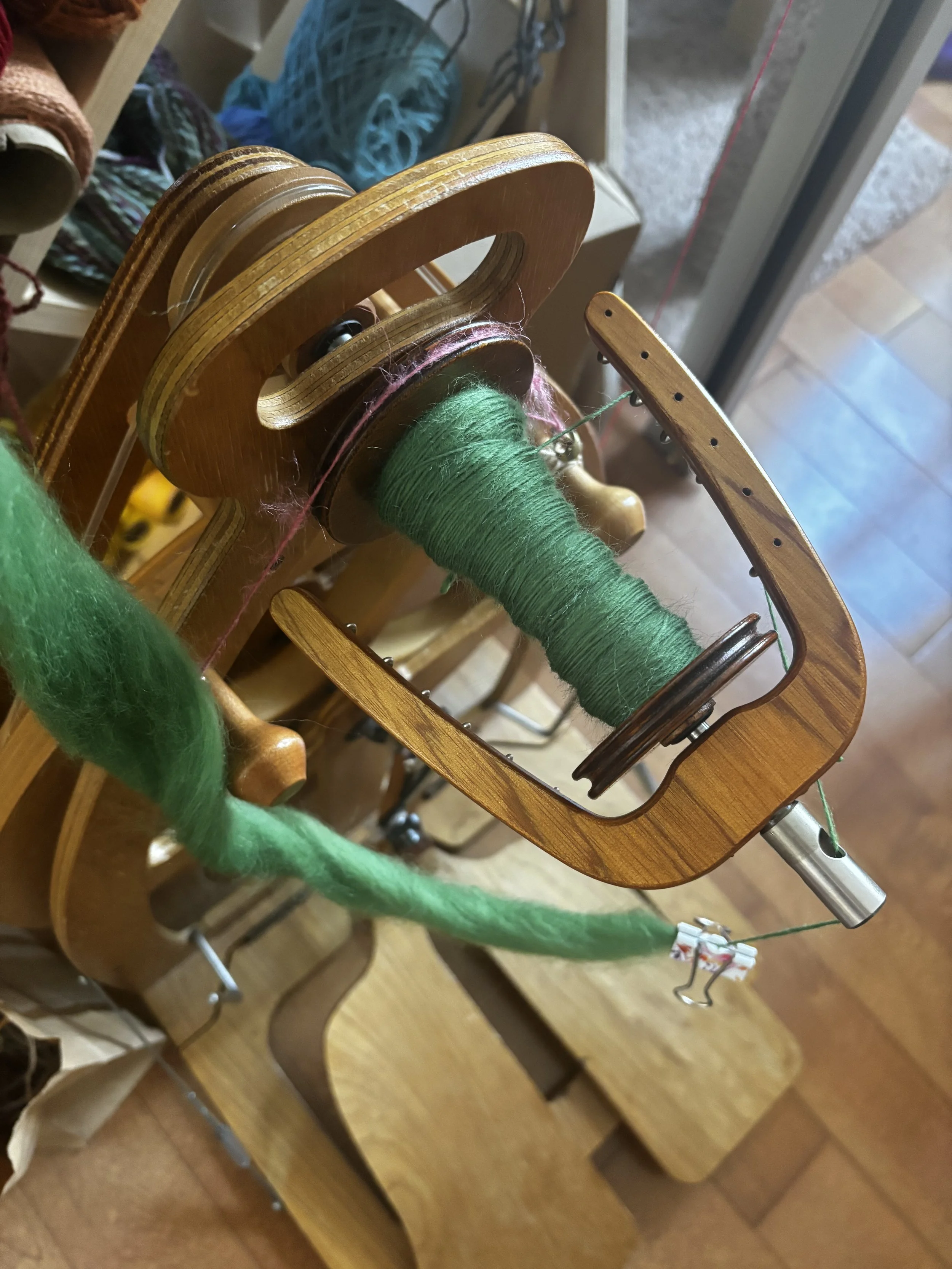
Now that’s what I call green!
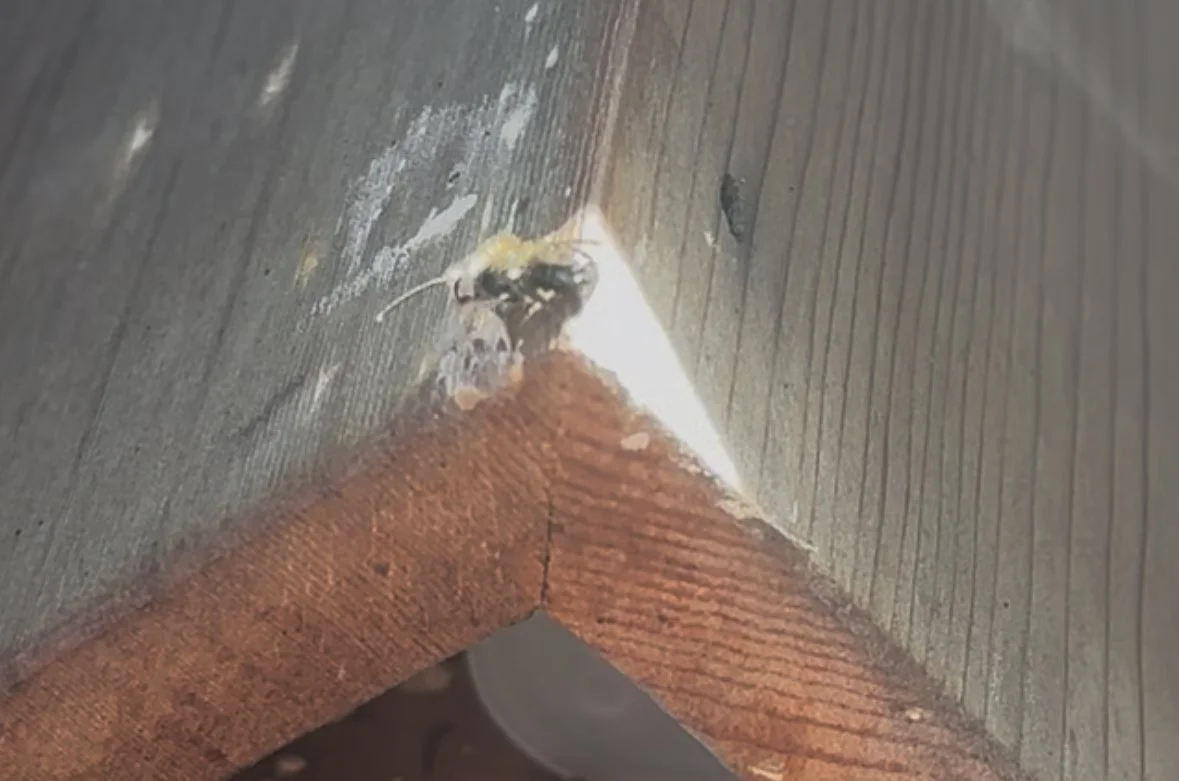
A bee rests in a small patch of sun immediately after hatching.
The Seattle Weaver’s Guild hosted tapestry weaver and Norwegian textile expert Robbie LaFleur for a three-day workshop to learn Frida Hansen’s transparent tapestry technique. Robbie offered great insight and knowledge about the tapestry construction, planning, and design process. I wove a snail, using the open warp to denote the spiral of the shell. A substantial conversation took place during the workshop about whether a snail is a bug. In any case, a critter was formed, and I’m quite pleased with him.
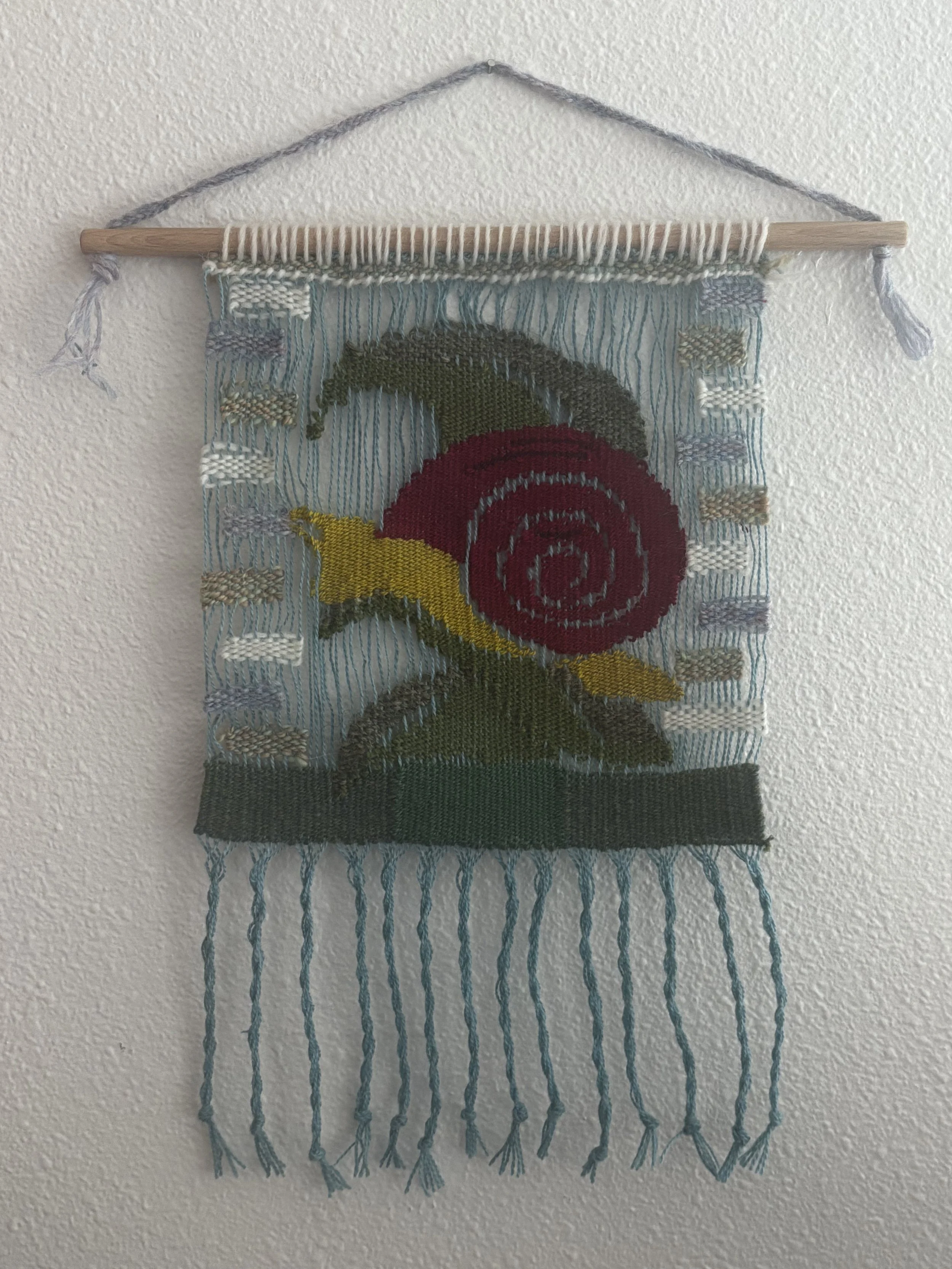
What do we name him?